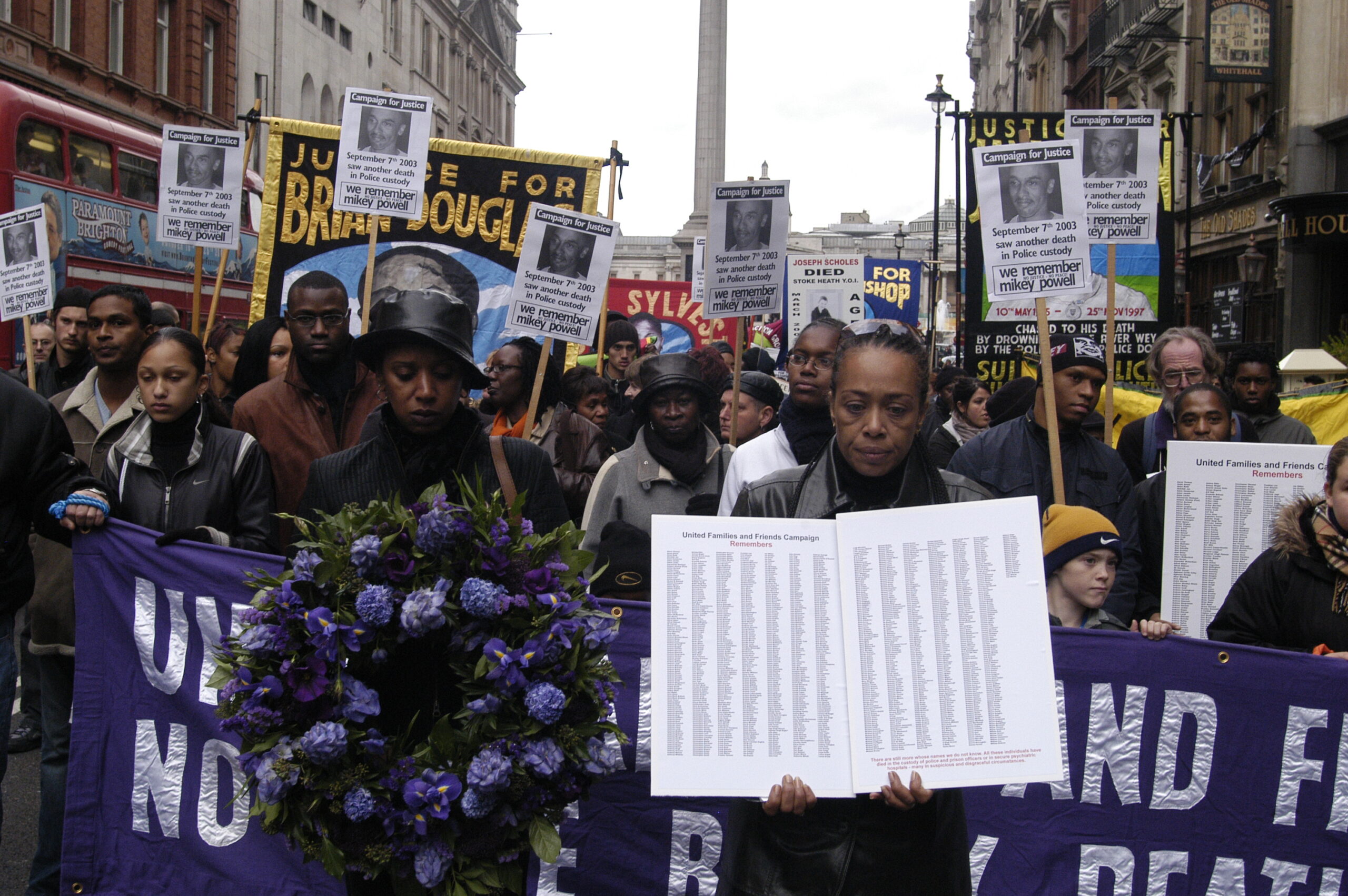
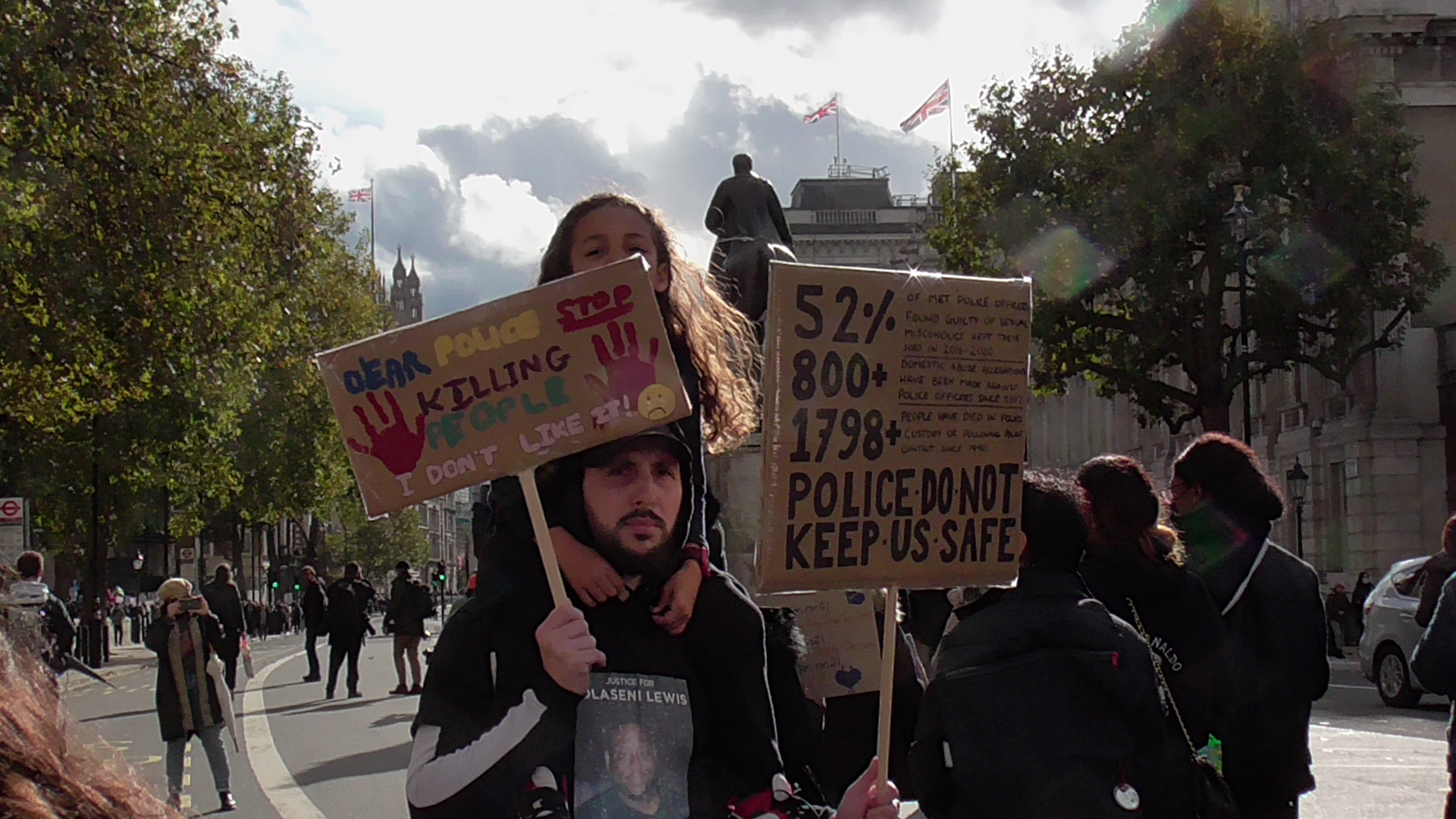
The People’s Tribunal hearings took place over the 5th & 6th April 2025 in London and, internationally, online. This tribunal centred hearing from the families whose loved ones have been killed by the police and have been part of our investigations over the last two years.
Over 500 people attended in person and thousands on line to hear oral evidence from the families, our expert witnesses and our use of force expert. You can read the evidence document here: PTPK Tribunal Document. The panel members asked questions throughout, before presenting their conclusions after hearing all the evidence.
30 family members – supported by more than 100 of their families – presented their testimonies over the two days, ensuring it was their stories, and the thousands others, are at the forefront of leading this movement for change.
Schedule
The evidence is presented using five different but interlinked perspectives to dismantle long-established narratives and articulate the truth and are detailed in the programme below:
DAY 1: SATURDAY 5 APRIL 2025
| TIME | SESSION |
| 10:00-11:30 | Overview and Introduction to the Tribunal |
| 11:30- 11:45 | BREAK |
| 11:45-13:00 | SESSION 1: TORTURE
Torture: a killing is never a discrete act in a given moment. Rather, death is preceded by acts of violence perpetrated by the police right up until the act or acts which results in the death—the act of killing. These are the restraints, the beatings, the suffocations, the assaults and the continuous infliction of pain and suffering on those unable to resist. Police violence and police killings are acts of torture. Families of:
Expert Witness: Asim Qureshi |
| 13:00 – 14:00 | LUNCH |
| 14:00 – 15:30 | SESSION 2: LANGUAGE OF COLLUSION
Language of Collusion: the collusion between the state, the media, and liberal institutions manifests in how their shared language functions to construct narratives and assert social control. It is these narratives that enable, justify and normalise police killings.
Expert Witness: Gargi Bhattacharyya |
| 15:30 – 15:45 | BREAK |
| 15:45 – 16:45 | Open Testimonies |
| 16:45 – 17:30 | Conclusion/Wrapping up |
| DAY 2: SUNDAY 6 APRIL 2025 | |
| TIME | SESSION |
| 10:00 – 10:15 | Short Introduction to the Tribunal |
| 10:15 – 11:30 | SESSION 3: TERROR
Terror: the violence of a police killing is not restricted to the individual killed; the trauma families endure continues through future generations. There is no ‘post’ to this trauma; this is recognised by our use of the term Continuing Traumatic Stress Disorder (CTSD). This trauma is amplified by the state’s treatment of the families and their communities, autopsies mutilate bodies, body parts are retained, access to evidence is denied. Families receive no state support; instead they are tracked, harassed, assaulted and subjected to long-term, targeted programmes of surveillance and intimidation. This pressure further undermines the mental health of family members, to the extent that some resort to taking their own life—an unattributed police killing. Families of:
Expert Witness: Luke Daniels |
| 11:30 – 12:00 | BREAK |
| 12:00 – 13:30 | SESSION 4: STATE COVER-UP
State Cover-ups: the inquest system acts as a form of legal containment; its effect is to protect the government and legal institutions. Despite decades of attempts to engage with this system in a process of reform, inquests and public inquiries have failed to prevent subsequent killings. It is a broken system controlled by the government, and despite decades of attempts at reform, inquests and public Inquiries have failed to prevent the next killing. Families of:
Expert Witness: Paul O’Connor |
| 13:30 – 14:30 | LUNCH – 60 MINS |
| 14:30 – 16:00 | SESSION 5: BLACK RESISTANCE
Black Resistance: is at the forefront of the movement because racism is at the core of the high-profile cases. Black resistance in the UK has manifested itself in many ways for decades. There have been victories as well as defeats, but the ability of people to fight for justice is undiminished. Today the issue of class needs to be centred in the approach to resist, and the expansion of UFFC to include white working-class families whose loved ones have been killed is essential to building the resistance, the struggle and the movement to create a critical mass. Establishing this Tribunal is the latest act for all who refuse to be silenced, who celebrate humanity, and who kindle flames of hope from despair. Families of:
Expert Witness: Gus John |
| 16:00 – 16:15 | BREAK |
| 16:15 – 17:00 | Legacies Testimonies |
| 17:00 – 17:30 | Conclusions – Panel closes the Tribunal Class Actions Announcement |

Participating families include those of:
Brian Douglas, Ibrahima Sey, Roger Sylvester, Christopher Alder, Kingsley Burrell, Mouayed Bashir, Shiji Lapite, Jason McPherson, Kebba Jobe, Leon Patterson, Rashan Charles, Paul Coker, Joy Gardner,Adrian McDonald, Marc Cole, Darren Cumberbatch, Sean Rigg, Henry Hicks, Mikey Powell, Olaseni Lewis, Edson Da Costa, Thomas Orchard, Kevin Clarke, Lloyd Butler, Sheku Bayoh, Ronaldo Johnson, Azelle Rodney, Harry Stanley, Aseta Simms, Nuur Saaed, Liam Phillips and Souheil El Khalfaoui, and more…
Expert Witnesses
Rod Charles
Rod Charles is a former Metropolitan Police officer, retiring in the rank of Chief Inspector after 30 years service. Beginning his career as a constable at Notting Hill, through combination of appointments and promotions subsequently served in boroughs in all four primary geographical zones and in Central London. Firearms, security co-ordinator and public order responsibilities further enhanced his experience managing incidents pan London and when deployed to various countries in Europe, to work in concert with international law enforcement agencies, to prevent adverse impact from and detect violent offenders. An advanced paralegal (Chartered Institute of Legal executives) also has a diploma in social policy and criminology. Currently engaged as an independent investigative researcher, focusing on abuse of power.
Paul O’Connor
Paul O’Connor is the manager at the Pat Finucane Centre in Derry, north of Ireland. The Centre has offices in Derry, Belfast and Armagh and also has a base in Dublin through its project Justice for the Forgotten and provides advocacy support to families bereaved through the political conflict on the island of Ireland. This support usually entails seeking documents and information from public bodies. Paul and other staff at the PFC have been mining the archives at the UK National Archives for many years. Paul is a graduate in Peace and Conflict Studies from the University of Ulster and lives in his native Derry. He has lived, worked, studied and/or volunteered in the US, Germany, Spain and Nicaragua.
Luke Daniels
Luke Daniels is a social and political activist, an author and father to eight children. He trained as a counsellor and worked at the Everyman Centre in London with perpetrators of domestic violence. His work with perpetrators was the subject of 1994 Channel 4 documentary, Pulling The Punches. He is the author of two books on ending violence against women and girls. He is President of Caribbean Labour Solidarity and a member of Nicaragua and Venezuela solidarity executive committees. He is chair of Islington Pensioners Forum and is an active campaigner for Reparations for trans-Atlantic chattel slavery.
Gargi Bhattacharyya
Professor Gargi Bhattacharyya is Director of the Sarah Parker Remond Centre for the Study of Racism and Racialisation at University College London. Professor Bhattacharyya is the author of Tales of dark-skinned women (1998); Sexuality and Society (2002); Dangerous Brown Men (2008); Traffick (2005); Crisis, Austerity and Everyday Life (2015); Rethinking Racial Capitalism (2018); We, the heartbroken (2023); The Futures of Racial Capitalism (2023). I have also co-authored books with colleagues (and continue to believe that collaborative work is an important element
of the project, despite the challenges it can bring). My collaborative works include: Race and Power (2001); Go Home? Mapping Immigration Controversy (2017); How media and conflicts make migrants (2020); Empire’s Endgame (2021).
Asim Qureshi
Dr Asim Qureshi graduated in Law (LLB Hons, LLM), specialising in International Law. He completed his Ph.D. in International Conflict Analysis from the University of Kent. He is the Research Director at the advocacy group CAGE International, and since 2003 has specialised in investigating the impact of counterterrorism practices worldwide. He has published a wide range of NGO reports, academic journals and articles. He has written the books Rules of the Game: Detention, Deportation, Disappearance (Hurst, Columbia UP, 2009); A Virtue of Disobedience (Unbound, 2019); the editor of I Refuse to Condemn: Resisting Racism in Times of National Security (Manchester UP, 2020) and When Only God Can See: The Faith of Muslim Political Prisoners (Pluto, 2024). Since 2009, he has been advising legal teams involved in defending terrorism trials in the US and at Guantanamo Bay, Cuba.
Gus John
Professor Gus (Augustine) John is an equality and human rights campaigner and an associate professor and honorary fellow of the UCL Institute of Education. Gus is an international consultant and executive coach and a scholar and activist, who is also an award winning author, lecturer and researcher. He is an associate professor of education and honorary fellow of the University of London (UCL) Institute of Education and Director of All Africa Advisors Ltd. As a management consultant and an educationalist, he has a deep commitment to life-long learning. He has worked internationally as an executive coach and a management and social investment consultant since 1990’s. He became the first African Director of Education and Leisure Services in Britain in 1989. He was named as one of 30 of the ‘Most Influential African Diaspora Leaders’ in 2016.
Tribunal Panel
Dr. Mona El-Farra
Dr. Mona El-Farra is a respected Palestinian physician, human rights and women’s rights activist, and healthcare advocate. Based in the Gaza Strip, she has dedicated her career to improving the health and well-being of Palestinians, especially women and children, under occupation. Through her roles in various health organizations and her outspoken advocacy, Dr. El-Farra has made significant strides in bringing attention to the healthcare crises in Gaza and mobilizing international support for Palestinian health and human rights.
Tony Doherty
Tony is Chair of the Bloody Sunday Trust in Derry, which is a human rights, peace-building and civil rights legacy conservation organisation. Its signal projects are the Museum of Free Derry, a highly successful social economy initiative, and Derry Peace and Conflict International – a peace and solidarity education project reflecting on Derry-based political and human rights achievements. The Trust welcomes fact-finding and learning delegations to its doors. In the late 1980s Tony was instrumental in creating the conditions for the Bloody Sunday Justice Campaign, which brought about a second public inquiry into the murders of 14 men and boys on Bloody Sunday, 30th January 1972. While its findings were far from perfect, it concluded that the deceased were innocent and that there was no legal justification for their deaths. One paratrooper, Soldier F, is due to stand trial in September 2025 for two murders and five attempted murders.
Emerson Caetano
Emerson is an expert on Human Rights and Racial Justice, advocating at the International Human Rights System for the topic of Reparative Justice for People of African Descent. He is a Master’s student of International Law at the Pontifical Catholic University of Rio de Janeiro, with a bachelor’s degree in International Relations at the Rio de Janeiro State University. Emerson holds a range of experiences coordinating social projects in the third sector field, having worked with the main actors of the global civil society and International Organizations such as the United Nations. Emerson Caetano is a Brazilian scholar and advocate committed to strengthening global governance and racial justice for Brazil and the world.
Mireille Fanon Mendes France
Mireille is a literature professor, also worked at the Université Paris V-René Descartes in cognitive educability and mediation of learning and peace, particularly in conflict resolution. She has also worked for Unesco Press, INSEE and as a legal adviser to the French National Assembly. She was a visiting professor at Lehigh University in the USA. A militant and activist on international law issues, she has written numerous articles and taken part in many national and international conferences. She has been appointed expert at the United Nations on issues of institutional racism, with particular reference to people of African descent. She initiated the creation of the Fondation Frantz Fanon. She is currently working on the issue of reparations in a decolonial perspective.
Joy James
Joy is Ebenezer Fitch Professor of the Humanities at Williams College and is a political philosopher who works with organizers. Her books include In Pursuit of Revolutionary Love; New Bones Abolition: Captive Maternal Agency and the (After)Life of Erica Garner; and Contextualizing Angela Davis: The Agency and Identity of an Icon. Her edited volumes with Pluto include Beyond Cop Cities: Dismantling State and Corporate-Funded Armies and Prisons and ENGAGE: Indigenous, Black, Afro-Indigenous Futures.
Esther Mamadou
Esther Mamadou is a human rights defender, activist, and jurist committed to the protection of the human rights of marginalized communities, particularly those of African descent. Qualified lawyer in Spain, she holds an LLM in International Law from SOAS University. With expertise in forced migration and refugee law, Esther has, since 2004, dedicated her career to addressing the racism faced by Africans providing legal advice on migrations and international protection in countries such as Spain, the UK, Colombia, and Ecuador. In 2018, Esther co-founded Equipo Decenio Afrodescendiente to combat anti-Black racism and police violence in Spain. At the EU and UN levels, she actively advocates for racial justice as a member of the steering group for the Equinox Racial Justice Initiative, where she supports the efforts to shape EU policies on racial justice. Additionally, she serves as the European coordinator for the International Coalition for People of African Descent, a platform for Afro-descendant organizations in Europe and the Americas as an alternative voice in the effort to dismantle structural racism and demand reparations for the historical injustices committed against Africans.